Our View on the Fed Rate Hike
Today (9/16/2026), the Federal Reserve raised its target range by 0.25% to 3.75%-4.00%, a move largely anticipated by markets: CME FedWatch placed the probability of at least a 25 bps increase near 93% this morning. With inflation still above the Fed’s desired level, Chair Warsh said, “I would be hard pressed to describe broad financial conditions as restrictive. This view was widely shared by the Committee, so we removed a dose of accommodation.” The Fed Chair reiterated the FOMC’s commitment to discipline, rather than a single decision, and will assess trends rather than react to any single data point.
While these actions do not directly control long-term Treasury yields, we at Stenger Family Office believe the 10- and 30-year yields can move significantly higher as the economy strengthens. Our fixed income portfolio’s low-duration positioning anticipates these moves in Treasury yields.
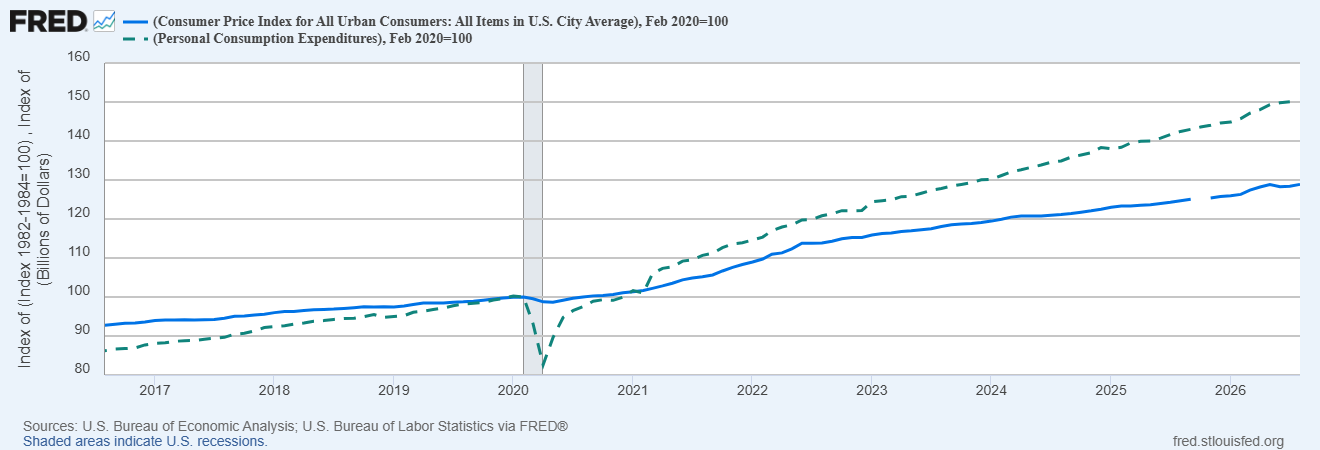
While headline inflation (CPI) has been hovering around 3.5% the past 12 months, the Fed’s preferred inflation gauge is the PCE Price Index, which captures a broader set of consumer expenditures than CPI-U and adjusts more readily for changes in consumer behavior. PCE tells a different story - that inflation could be tracking closer to 5.9%.
With more decisive Fed action to address inflation potentially on the horizon, we believe a materially higher 10-year Treasury yield may follow. See below for the difference between PCE and CPI.
Implications for Investors
We continue to remind you that equities are volatile, and have been saying for months, that we could be due for a 5-15% correction. The S&P 500 Index is already down 3.4% from its all time high and we think this pullback could continue a bit further. Let not your heart be troubled - corrections are a normal part of owning companies and are the best hedge against inflation over the long run.
If you have a 3+ year time horizon, you should remain invested, turn off the TV and do absolutely nothing. If you have a goals based, proactively designed plan, these corrections never matter in the long run. If you have a risk-based plan, we recommend converting to a goals-based plan that is not reacting to market volatility.
For those of you who have been following us the past 6 years, you will remember we have urged caution owning long-term bonds. We still do not believe now is the time to own duration or risky credit. It's highly possible we could see the 10-year reach 6.5-7.0% before tapering off, a significant risk to the downside for bond holders. For clients, we will maintain 30-day maturities with your safe money.
We believe very strongly that despite higher inflation and higher interest rates, the underlying U.S. economy is still strong and earnings will outpace input costs thanks to technology. Rather than entering stagflation, we believe this era is more emblematic of the 1980's where we had high inflation alongside high growth. This is yet another reason to stay on your plan and continue owning U.S. high quality equities despite any short term volatility we are likely to experience.
The climb to S&P 8,000 is still on target. Companies and entrepreneurs are innovating at light speed - technology has never moved as fast as it does today. The market never moves up in a straight line to the right, and because of this, equities command a premium over every other asset class. The price we pay to own equities is volatility. And in the end, every correction we've experienced the past 200 years has been a buying opportunity for patient, long term investors.
Nick Stenger
Chief Executive Officer
Financial Advisor
Jerry Goeden, CPA, CFA
Senior Vice President
Portfolio Manager
Financial Advisor in Chicago, IL
Stenger Family Office - Chicago Financial Advisors
150 N. Riverside Plaza
Suite 1950
Chicago, IL 60606
(630) 912-8295
Other office locations:Naperville, IL | Houston, TX | Baton Rouge, LA